Wanda:A Simple and Effective Pruning Approach for Large Language Models
剪枝算法核心:
- 对于每个weight,使用它的magnitude和对应input activations的norm的乘积来进行评估
- On a per-output basis instead of across the whole layer(weight importance score are compared within each row in W)
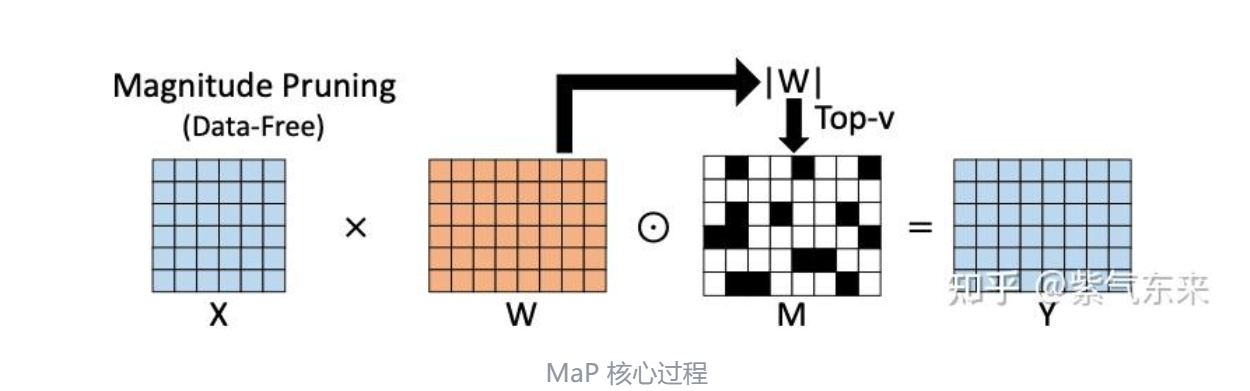
Magnitude Pruning: 将权重低于某个阈值的全部剪枝,之后进行fine-tuned直到准确率到达预期。
\(\(M_{ij}= Top_v(S)_{ij}= \begin{cases} 1& \text{if\ Sij in top v\% }\\ 0& \text{otherwise} \end{cases}\)\),其中\(S_{ij}\)表示重要性分数。对于ReLU来说\(Y=max(0,XW)\),结果就变成了\(Y=max(0,X(W\odot M))\),\(\odot\)表示Hadamard积,黑色代表1。
Wanda的核心过程Overview如下图所示:
- 两种Weight Update
- Sequential:先计算出完整的pruned mask,再对权重进行更新
- Iterative: SparseGPT所采用的方法, 在每一个Layer内部迭代的进行剪枝和权重更新,SparseGPT将128个Input channel作为一个comparison group来进行更新。
- Weight Update对Wanda的优化效果可以忽略(It offers little or negligible improvement to Wanda.)
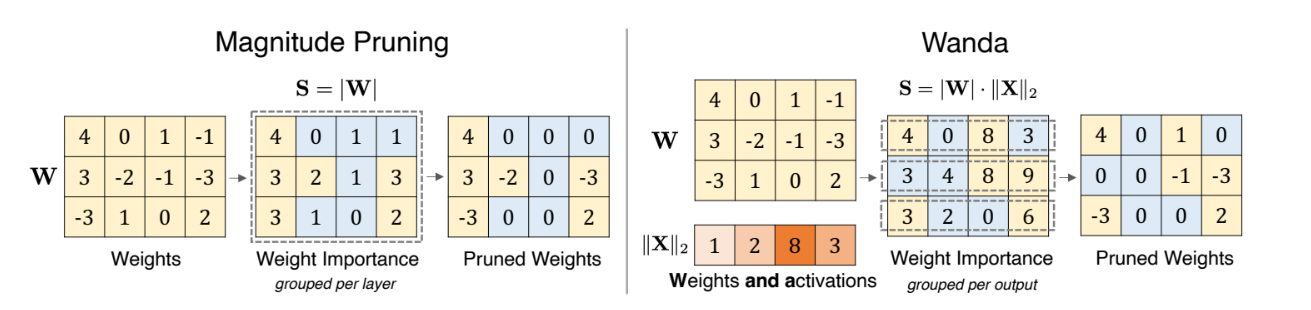
Pruning Metric:
假设一个线性层的\(W\in R^{C_{out}\times C_{in}}\), Input activations \(X\in R^{NL\times C_{in}}\),对于某个weight\(W_{ij}\),Score可以计算如下:\(S_{ij}=|W_{ij}|\cdot||X_j||^2\),前者代表绝对值,后者是\(j\)th feature的L2范数(即第j行)
Comparison Group:
如上文所说,与传统的layer-wise和whole-network不同,Wanda中的Comparison group是output neuron,也就是output矩阵的每一行。用公式表示就是\(For\ W_{ij},\ G_{ij}=\{W_{uv}|u=i\}\)