PIM-DL: Expanding the Applicability of Commodity DRAM-PIMs for Deep Learning via Algorithm-System Co-Optimization
三点核心贡献:
- PIM-DL: 提出了第一个在DRAM-PIMS上的DL框架,使用 LUT-based deep-learning paradigm
- 提出了增强的LUT-NN算法来进行模型校准
- 设计了LUT-NN在DRAM-PIM上的映射,并对数据流进行定量建模。提出了一个Auto-tuning框架来优化在不同DRAM-PIM平台上的映射
eLUT-NN:
对于某一层,different input activation matrices的features具有块语义相似性,所以可以用这些称为centroids的特征来近似整个矩阵,而原本的GEMM操作可以转化为centroids和weight的乘法。
通过提前得到centroids,那么就可以提前计算出centroid和对应weight的值(称为partial-sums)并存入到_look-up tables_。在Inference过程中,我们仅需根据和当前Input最接近的centroids' indices从LUTs中取出Pre-computed data,再进行reduction就可以得到原先GEMM的结果。
LUT-NN Conversion
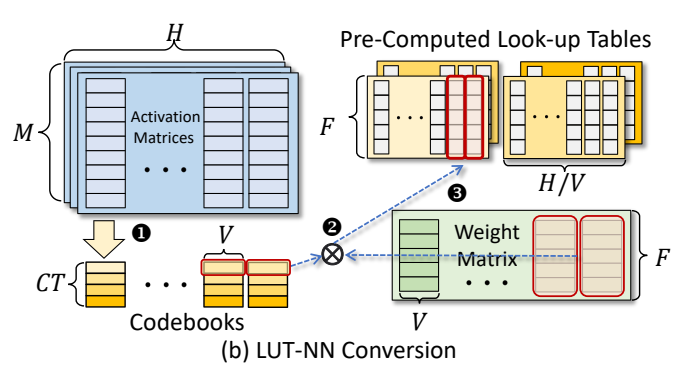
假设Activation Matrices大小是\(M\times H\)。
- 沿着\(H\)维度,我们将其分成\(1\times V\)的子向量,因此每一行会得到\(\frac{H}{V}\)个子向量。然后,对这M个向量(within the column, then what's mean across activation matrices)执行K-means算法,得到四个centroid向量,称作codebook。
- 将Weight matrix(\(F\times H\))沿着\(H\)维度分解成\(F\times V\)的子向量,然后与对应的codebook中的向量进行inner-products(向量点乘),四个向量会产生四个LUT,大小是\(F\times \frac{H}{V}\)
LUT-NN Inference
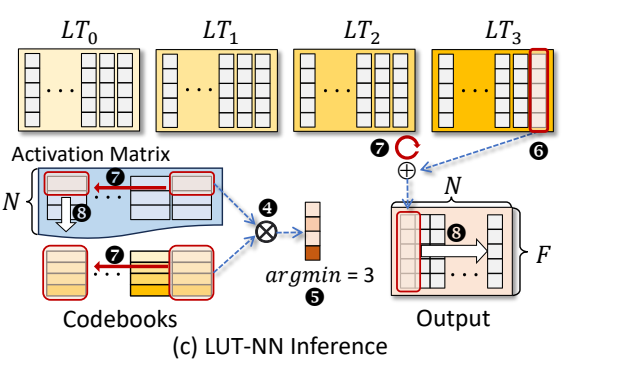
- Inference过程中,对于Input activation matrix,将其分解成\(\frac{H}{V}\)个\(1\times V\)的tiles,将每个tile中的vector与对应的codebook中的centroid进行点乘并找到最小值(closest L2-distance with inner products)。
- 根据最小值对应的centroid的index,从对应的LUT(codebook中每个centroid对应一个LUT)中读出一列数据。
- 对于矩阵的每一行,从LUT中找到的\(F\times 1\)的向量进行accumulate得到本行最终计算结果。遍历所有行将所有行的结果拼接起来,就得到了\(F\times M(N)\)的结果
计算变化:
- GEMM: \(N\times H\)的矩阵和\(H\times F\)的矩阵相乘,需要\(2NHF\)的计算,\(NHF\)是乘法,\(NHF\)是加法
- LUT-NN:
- Index Calculation: \(3\times N\times \frac{H}{V} \times V \times CT=3NH\times CT\),加法乘法和Min
- Result Accumulation: \(N \times \frac{H}{V}\times F\), 加法操作
PIM-DL Framework
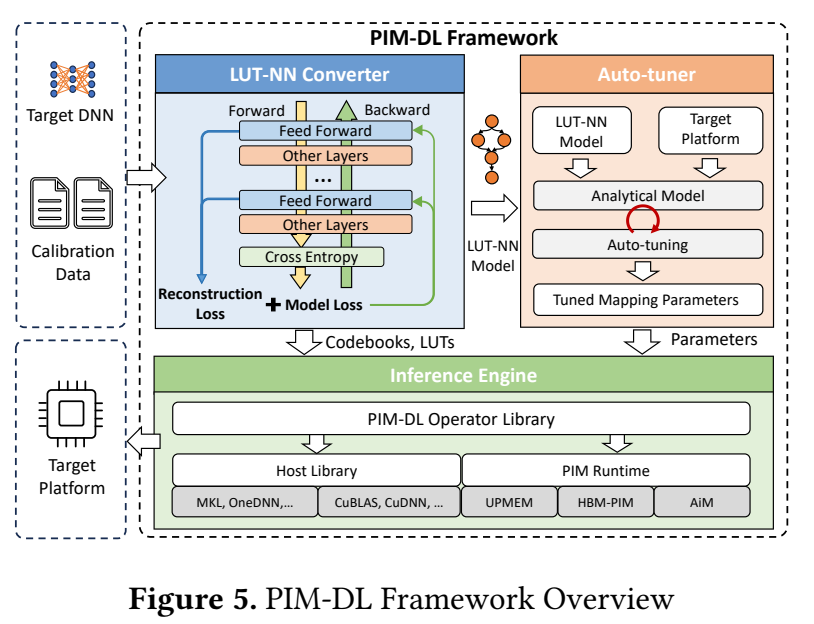
从下图中可以看到,PIM-DL Framework由三部分组成,LUT-NN Converter,Auto-tuner和Inference Engine组成。解决了当前的LUT-NN替换精度不高,不同硬件特性不同以及没有同时支持CPU/GPU和DRAM-PIM DL serving框架的问题
LUT-NN Converter
eLUT-NN校准算法: High data efficiency and High model accuracy,使用两个技术来进行模型校准,High data efficiency and High model accuracy
- Reconstruction Loss for computation approximation
- Straight Through Estimator for gradient propagation.
Reconstruction Loss for computation approximation
Reconstruction Loss收集了所有被替换Layer的error和原始的model loss来构建LUT-NN's 校准损失L:
\(L=\text{Model Loss}+\beta\sum_{l\in L}||\hat{A_l}W-A_lW||^2\),其中\(A\)代表原始矩阵,\(\hat{A}\)代表用centroid替换后的矩阵,\(l\)代表layer \(l\).
- Enable direct gradient propagation
- Enable the centroids to learn accurate representations of activations
Straight Through Estimator for gradient propagation
由于centroid clustering and table-lookup operators不可微,所以使用STE来估计梯度和反向传播,F是Layer Input的生成函数。
STE:近似地处理离散变量的梯度,在前向传播过程中使用离散变量的值,在反向传播的过程中将离散变量的梯度设置为单位矩阵。这样在传播过程中,梯度会被无修改的传递到上一层。
\(\dfrac{\partial L}{\partial F}=\dfrac{\partial L}{\partial \hat{y}} \cdot\dfrac{\partial \hat{y}}{\hat{A}}\cdot \dfrac{\partial\hat{A}}{\partial A} \cdot\dfrac{\partial A}{\partial F}\approx \dfrac{\partial L}{\partial \hat{y}} \cdot\dfrac{\partial \hat{y}}{ \hat{A}}\cdot\dfrac{\partial A}{\partial F}\),其中\(\hat{y}=\hat{A}\cdot W\),是本层的输出。
PIM-DL Engine
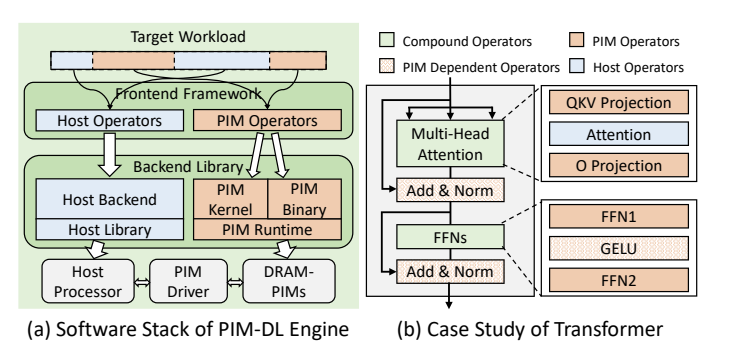
PIM Operators:
- PIM Kernel: 在host上触发PIM module来执行workload
- PIM Binary: 在PIM module中describe offloaded workload
Host Processor通过PIM Driver来控制DRAM-PIMs的执行,在Transformer的执行过程中,将QKV Projection,O Projection, FFN这些线性层都替换为LUTs。Attention在host上执行,其余的Add,Norm, GeLU都在PIM上执行
Hardware Mapping and Optimization
LUT-NN's mapping strategy and PIM-DL Auto-Tuner: 产生input LUT-NN和target hardware platform的best mapping parameters
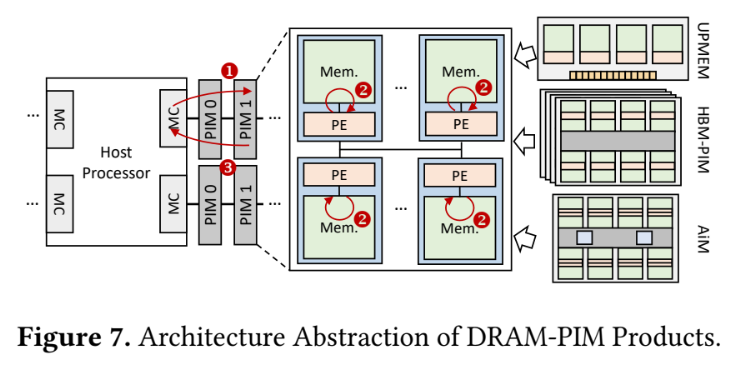
DRAM-PIM架构图:在每个PIM module中,有很多分布式的计算节点。每个节点由一个Processing Engine和local memory banks组成。核心在于所有的PE可以同时进行内存访问,所以内存带宽很高,相较于一般的计算密集型设备
执行PIM workload分为三步:host processor准备输入数据并发送到PIM modules,准备好后host会启动PIM kernel,当所有的PE执行完Kernel execution后,host会从所有的PIM module获取结果。
不过DRAM-PIM有一些缺点:
- Constrained Host-PIM communication:所有的PE共享一条数据总线,所以每个PE的传输速率有限,所以尽可能的使用broadcast
- No direct inter-PE datapath: 由于on-chip的routing resources有限,所以inter-PE之间没有直接的数据通路,所以得尽量避免inter-PE communication
- Load-balancing problem: 短板效应
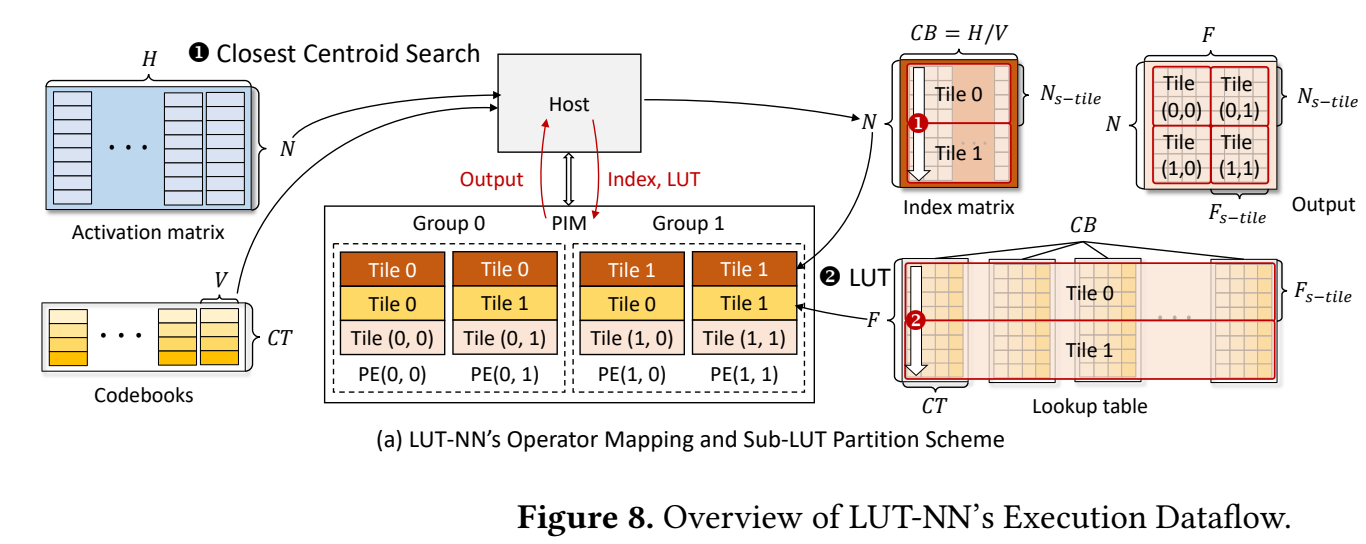
LUT-NN的两个operator: CCS(closet centroid search)和LUT(table lookup operator),CCS在host上计算,LUT在PIM上计算
-
LUT: 分为两步,第一步是将LUT划分为sub-LUT workloads,第二步是在所有的PE上并发的启动所有的kernel
-
Sub-LUT Partition: 注意图中Lookup Table的CB和CT进行了Transpose,在图中,对于CCS获得的Index matrix和Pre-computed LUT,分别沿着N和F两个维度进行PE group之间的均分。\(i\)-th PE group负责计算\(i\)-th index tile,即图中的红色部分。PE group中的\(j\)-th PE负责计算对应index tile和\(j\)-th LUT tile的table lookup。
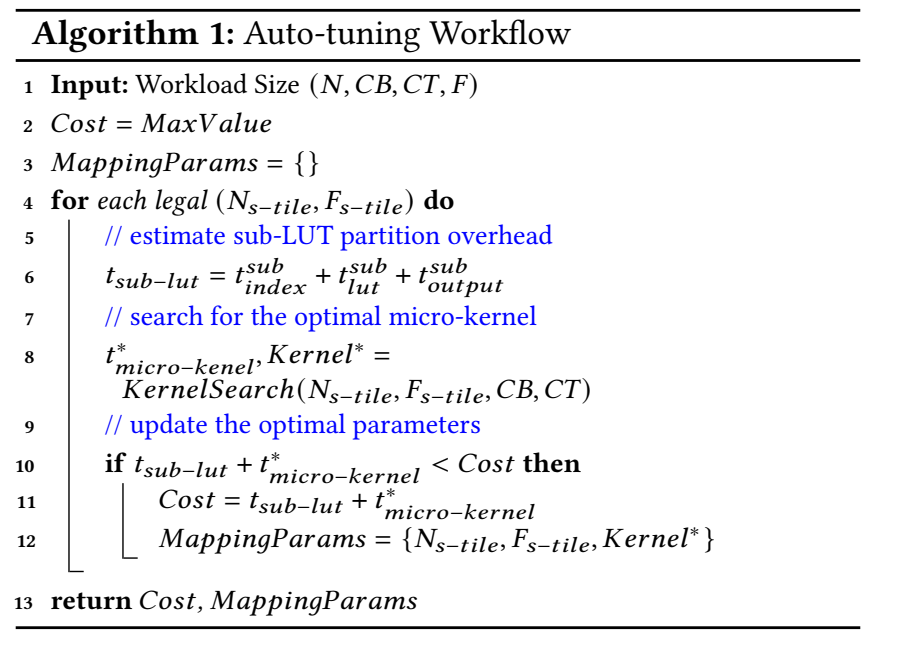
\(t_{sub-lut}=t_{index}+t_{lut}+t_{output}\)
这样做有一些好处:
- 在同一个PE group中的所有PE共享同一个index tile,所有的group中的\(j\)-th PE共享同一个LUT tile,充分了利用了host-PIM带宽
- CT维度没有分割,避免了inter-PE communication
- 均匀分割保证了workload的均衡
-
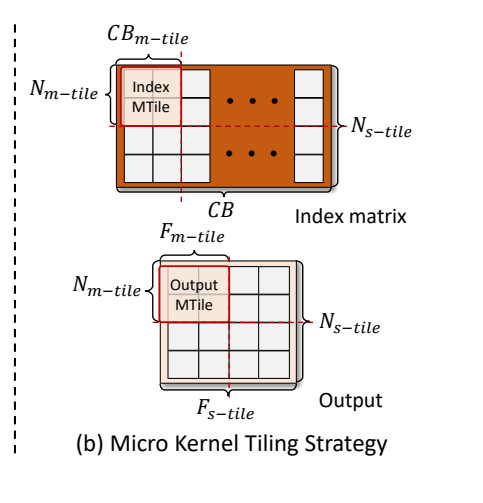
Micro Kernel Execution: 对于Output中的每个\(N_{s-tile}\times F_{s-tile}\)的tile,为了利用PIM上的on-chip buffer,继续进行分块,对于\(N_{s-tile}\times CB\)的index matrix,在两个维度上继续进行分块,称为M-tile。每个PE加载一个index Mtile,然后通过LUT产生一个output Mtile,对于每个Mtile, 需要将所有同行的\(N_{m-tile}\)加起来得到最终的output Mtile
\(t_{micro-kernel}=t_{transfer}+t_{reduce}\)
-
PIM-DL Auto-Tuner
主要找的是四类参数:
- Sub-LUT Tiling Factors: \(N_{s-tile}\)和\(F_{s-tile}\)
- Micro Kernel Tiling Factors: \(N_{m-tile}\), \(CB_{m-tile}\), \(F_{m-tile}\)
- Tile Traversal Order: 即上述的三个Mtile factors的遍历顺序
- LUT load scheme:三种LUT matrix的load scheme
- Static Load:当LUT的Mtile小于on-chip buffer size时,就将整个Lookup Table tile(\(CB_{s-tile}\times CT \times F_{s-tile}\))加载到buffer中
- Coarse-grained load: 考虑到每个Index会从\(CT\) candidates中选取一个,所以每次加载\(CB_{load-tile}\times CT \times F_{load-tile}\)大小的LUT tile到buffer中
- Fine-grained load: 在这种方法中采取on-demand的方法,具体是每当处理一个新的index时,就沿着F维度加载\(F_{load-tile}\)的elements,当并行处理多个read-request时,可以为每个线程keep一个\(F_{load-tile}\)大小的Buffer